

- Econometrics
- Time Series Analysis
Degree
- Ph.D. in Economics (University of North Carolina at Chapel Hill)
Research Interests
Econometrics
My field of specialization is econometrics, which can be thought of as statistics customized for economic data. To discover laws in the real-world economy, we should analyze data and interpret the result correctly. Econometrics underpins this process by supplying statistically plausible and economically insightful methods. In this sense, econometrics plays a role of engineering in economic analysis.
Economic data can broadly be classified into time series data and cross-section data, each of which requires different econometric methods. Time series data are data with multiple time periods for a single individual; a simple example would be the monthly Japanese unemployment rate from January 2000 through December 2020. Cross-section data are data with multiple individuals at a single time period, such as country-wise unemployment rates in December 2020. I am primarily interested in time series analysis, although I sometimes explore other fields of econometrics. In what follows, I introduce my time series projects.
Time series analysis
The goal of time series analysis is to characterize patterns in time series data and to forecast the future. Time series observations accumulate as time passes from the past to the present and to the future. The basic approach of time series analysis is modelling a variable based on its past and present observations and predicting its future values. Potential applications include forecasting corporate financial performance, detecting bubbles and crashes of financial markets, and predicting macroeconomic indicators such as economic growth and inflation. Beyond economics, time series analysis is applied extensively in social sciences and natural sciences, with examples including the monitoring of virus infections and climate changes.
A primary mission of time series econometricians is to improve the model fit and forecast accuracy. This mission can be pursued by selecting or inventing methods which are compatible with the characteristics of variables of interest. The improved accuracy has positive impacts on the efficiency of companies’ management strategies, investors’ portfolio strategies, and governments’ policy strategies. Motivated by these backgrounds, I propose new methods useful for economic analyses. My previous and ongoing projects include characterizing the lead-lag relationship of multiple variables, testing the unpredictability hypothesis of target variables, and incorporating asymmetric responses called threshold effects. In my empirical studies, I analyze a wide range of variables such as macroeconomic indicators, asset prices, and COVID-19 statistics.
I am particularly interested in the analysis of mixed frequency data. Classical time series analysis requires all target variables to have the same sampling frequency. Consider analyzing a dynamic interaction between unemployment and gross domestic product (GDP), for example. For many countries, unemployment statistics are announced monthly while GDP statistics are announced quarterly. The classical approach forces us to aggregate monthly unemployment data into a quarterly level before formulating a bivariate model. Such a temporal aggregation causes the loss of information, lowering the precision of statistical inference. Exploiting all observations available should lead to the highest possible accuracy, whatever their sampling frequencies are.
The methodology of avoiding temporal aggregation began to be explored around 2004. Such an approach is broadly acknowledged as “Mixed Data Sampling (MIDAS)”. In the current literature, there is a consensus that the MIDAS approach improves the accuracy of economic forecasting compared with the classical approach involving temporal aggregation. I have been studying the theory and practice of MIDAS since I was a Ph.D. student at the University of North Carolina at Chapel Hill in 2009—2014. I believe that my research outcomes contribute to the technical advance of MIDAS and the better understanding of economic dynamics.
Lectures and Seminars
Teaching Experience
Statistics (Undergraduate)
This is a required field course for undergraduate freshmen. We learn the foundation of statistics through this course. There is a massive amount of data available in the modern society. Correct analysis of data helps us find laws in the real world and clues for addressing social problems. Statistics is essential for plausible data analysis.
This course consists of three sections: (1) descriptive statistics, (2) transition from descriptive statistics and inferential statistics, and (3) inferential statistics. The goal of descriptive statistics is to visualize and summarize data given, whereas the goal of inferential statistics is to infer a latent mechanism generating the given data.
In the first section of descriptive statistics, we study frequency tables, histograms, sample mean, sample variance, and sample correlation coefficients, among others. In the second section of the transition from descriptive statistics to inferential statistics, we cover probability, random variables, normal distributions and related distributions, random sampling, the Law of Large Numbers, and the Central Limit Theorem. In the third section of inferential statistics, we elaborate the estimation and hypothesis testing of unknown parameters. Throughout the course, students are encouraged to understand each technical concept from three perspectives: words, equations, and figures/tables.
Econometrics (Undergraduate)
This is an optional field course for undergraduate sophomores. We learn the foundation of econometrics through this course. Econometrics can be thought of as statistics customized for economic data. Econometrics is useful when we test if an economic hypothesis holds in the real world and when we refine the economic hypothesis from practical perspectives. Focusing on regression analysis, this course offers the theory and practice of econometrics. The regression analysis is an analytical method which explains the variation of a dependent variable Y with the variation of an explanatory variable X.
Topics of this course include linear regression models, ordinary least squares, the coefficient of determination, Gauss-Markov Theorem, t-test, multiple explanatory variables, and F-test. I also present some empirical applications on real estate data and corporate financial data to show how econometrics is utilized in practice. As in Statistics, students are encouraged to understand each technical concept from three perspectives: words, equations, and figures/tables.
Time Series Analysis (Graduate)
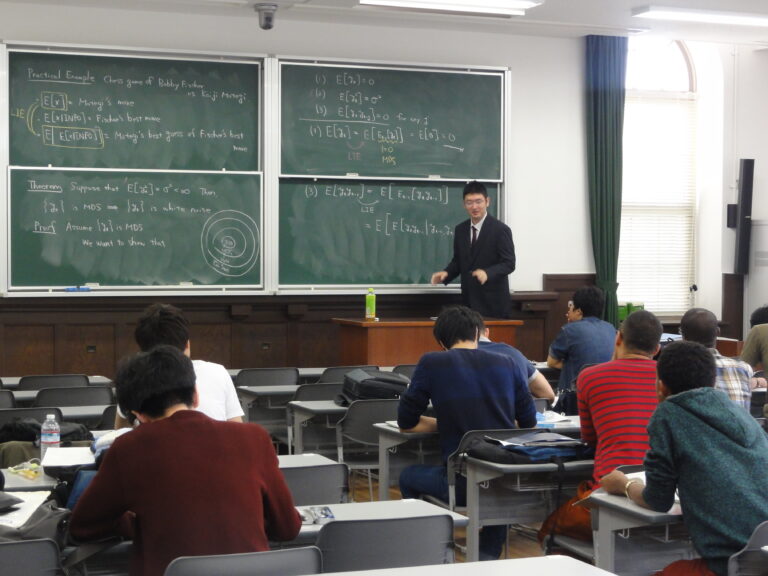
This is an optional field course for graduate students. We learn the theory and practice of time series analysis through this course. Time series variables are broadly categorized into stationary and non-stationary variables, and this course covers both of them. A stationary variable fluctuates temporarily around a fixed mean over time, whereas a non-stationary variable has a time-dependent mean or deviates permanently from a fixed mean. Many economic time series are non-stationary in levels and stationary in the first difference. Students are therefore encouraged to learn how to handle both stationary and non-stationary variables.
This course covers autoregressive moving average models (ARMA), autoregressive conditional heteroscedasticity (ARCH), vector autoregressions (VAR), unit root processes, spurious regression, cointegration, and vector error correction (VEC). While a main focus of this course lies in theory and simulation, I also present some empirical examples on macroeconomic indicators and financial markets.
Lectures and Seminars
Seminar for undergraduate students
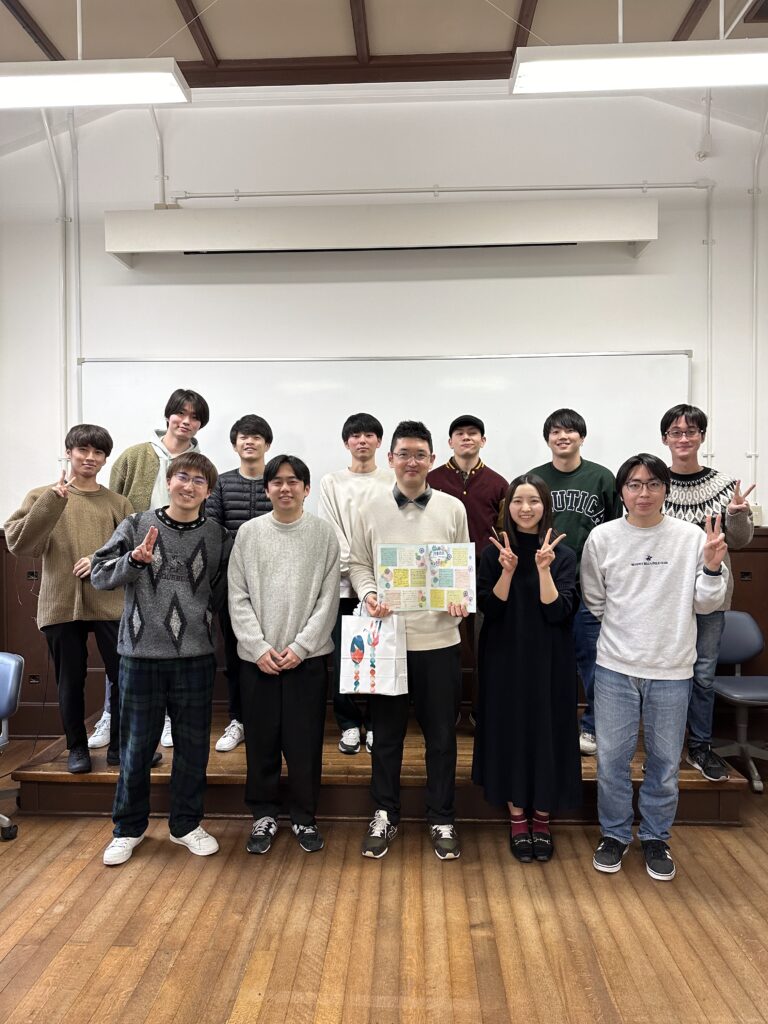
Starting April 2020, I supervise undergraduate students. The goal of my seminar course is that students become able to perform sensible statistical analysis of economic data. Juniors are assigned textbooks on econometrics and programming, and seniors write and present their theses. The topic of the thesis can be freely chosen as far as it contains data analysis. As of this writing, two students won the Best Graduation Thesis Award (Shiraki Award) and one student published a refereed journal article jointly written with me.
Seminar for graduate students
Starting April 2020, I supervise graduate students. In my seminar course, we write scholarly papers on econometrics and especially time series analysis. The papers are expected to be a part of students’ master’s or Ph.D. theses and submitted to refereed English journals. In their papers, students are encouraged to propose new econometric methods that outperform existing methods, and to demonstrate the superiority of the proposed methods mathematically, numerically, and empirically. This is certainly a challenging process, but it is highly appreciated in the economics literature to establish innovative methods. As of this writing, one of my students published a refereed journal article jointly written with me.
Message
I was fascinated with econometrics and time series analysis when I was an undergraduate student. Since then, my lifework has been studying and teaching econometrics. It has been twenty years since my bachelor’s days, and my passion is ever growing. I will try to make my courses as clear and inspiring as possible so that my students can appreciate how interesting and useful econometrics is.
Main Publications
Refereed journal articles
- E. Ghysels, J. B. Hill, and K. Motegi (2016). Testing for Granger causality with mixed frequency data. Journal of Econometrics, vol. 192, pp. 207-230.
- K. Motegi and A. Sadahiro (2018). Sluggish private investment in Japan’s Lost Decade: Mixed frequency vector autoregression approach. North American Journal of Economics and Finance, vol. 43, pp. 118-128.
- J. B. Hill and K. Motegi (2019). Testing the white noise hypothesis of stock returns. Economic Modelling, vol. 76, pp. 231-242.
- S. Hamori, K. Motegi, and Z. Zhang (2019). Calibration estimation of semiparametic copula models with data missing at random. Journal of Multivariate Analysis, vol. 173, pp. 85-109.
- J. B. Hill and K. Motegi (2020). A max-correlation white noise test for weakly dependent time series. Econometric Theory, vol. 36, pp. 907-960.
- K. Motegi, X. Cai, S. Hamori, and H. Xu (2020). Moving average threshold heterogeneous autoregressive (MAT-HAR) models. Journal of Forecasting, vol. 39, pp. 1035-1042.
- E. Ghysels, J. B. Hill, and K. Motegi (2020). Testing a large set of zero restrictions in regression models, with an application to mixed frequency Granger causality. Journal of Econometrics, vol. 218, pp. 633-654.
- S. Hamori, K. Motegi, and Z. Zhang (2020). Copula-based regression models with data missing at random. Journal of Multivariate Analysis, vol. 180, #104654.
- C. Ai, O. Linton, K. Motegi, and Z. Zhang (2021). A unified framework for efficient estimation of general treatment models. Quantitative Economics, vol. 12, pp. 779-816.
- K. Motegi and Y. Iitsuka (2023). Inter-regional dependence of J-REIT stock prices: A heteroscedasticity-robust time series approach. North American Journal of Economics and Finance, vol. 64, #101840.
- K. Motegi and S. Woo (2024). A note on the exponentiation approximation of the birthday paradox. Communications in Statistics – Theory and Methods, vol. 53, pp. 6417-6426.
- K. Motegi and S. Hamori (2025). Conditional threshold effects of stock market volatility on crude oil market volatility. Energy Economics, vol. 143, #108189.
- K. Motegi and S. Sugano (2025). Cross-regional spillover effects of sustainability indices: A heteroscedasticity-robust VAR approach. International Review of Financial Analysis, vol. 108, #104678.
- K. Motegi and S. Hayashi (2026). A groupwise approach to the birthday paradox. Communications in Statistics – Theory and Methods, vol. 55, pp. 640-658.
Contact
motegi(at)econ.kobe-u.ac.jp
Office hours
By appointment